Webinars

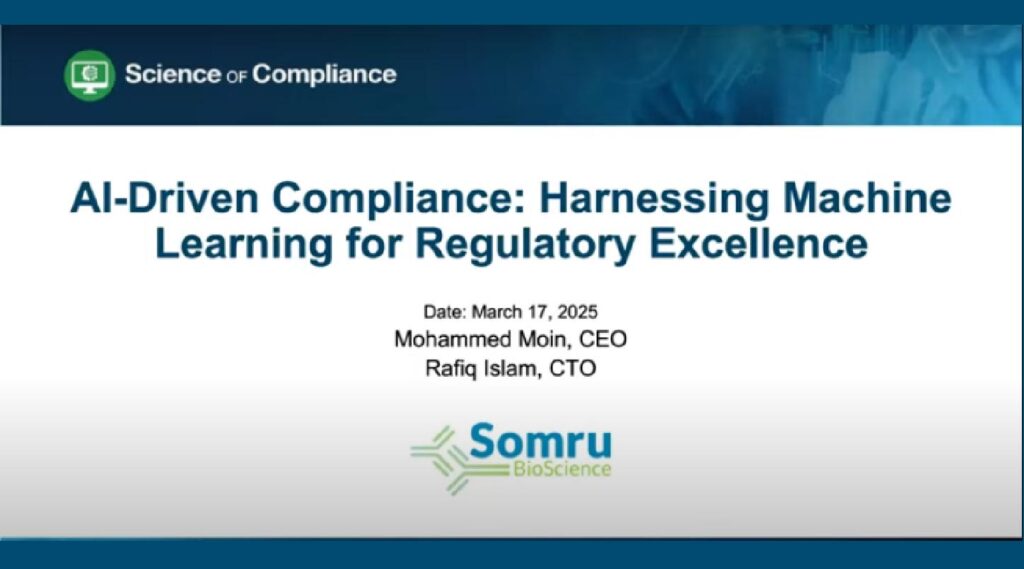
AI-Driven Compliance: Harnessing Machine Learning for Regulatory Excellence

Now Streaming On-Demand The bioscience industry operates within a highly regulated environment, where adherence to compliance standards is critical for patient safety, product efficacy, and market approval. Regulatory bodies such as the FDA, EMA, and WHO enforce stringent guidelines covering drug development, clinical trials, manufacturing, and post-market surveillance. However, ensuring regulatory compliance has traditionally been a resource-intensive and time-consuming process, often prone to human error and inefficiencies.Artificial Intelligence (AI) and machine learning (ML) are revolutionizing regulatory compliance by automating complex processes, enhancing accuracy, and enabling proactive risk management. By leveraging AI-driven solutions, bioscience organizations can streamline compliance workflows, optimize data analysis, and mitigate regulatory risks in real time. Key Applications of AI in Regulatory Compliance 1. Automated Documentation and Reporting Regulatory submissions require extensive documentation, from clinical trial data to pharmacovigilance reports. AI-powered Natural Language Processing (NLP) systems can automate the extraction, organization, and validation of compliance-related documents, reducing human workload and improving accuracy. 2. Intelligent Risk Assessment Machine learning models analyze vast datasets to identify potential compliance risks. Predictive analytics can flag anomalies in clinical trial data, detect deviations in Good Manufacturing Practices (GMP), and anticipate regulatory concerns before they escalate. 3. Pharmacovigilance and Adverse Event Detection AI algorithms can monitor real-world data from electronic health records (EHRs), social media, and scientific literature to detect adverse drug reactions. Automated signal detection helps regulatory teams respond swiftly to emerging safety concerns. 4. Compliance Audits and Inspections AI-driven tools assist in internal audits by analyzing historical compliance data and identifying areas of non-conformance. Automated checklists and digital assistants help ensure that companies are audit-ready at all times. Challenges and Considerations Despite its advantages, AI-driven compliance comes with challenges, including data privacy concerns, algorithm transparency, and integration with existing regulatory frameworks. To maximize AI’s potential, regulatory authorities and bioscience firms must collaborate on ethical AI guidelines, ensuring that machine learning models remain interpretable and aligned with legal requirements. Conclusion AI-driven compliance is transforming the bioscience sector by improving efficiency, reducing costs, and enhancing regulatory adherence. As machine learning continues to evolve, its integration into compliance strategies will drive regulatory excellence, ultimately fostering safer and more effective healthcare innovations.             Watch Now!         Complete the form to view the recording.  

Mitigating target interference challenges in bridging immunogenicity assay to detect anti-tocilizumab antibodies

Now Streaming On-Demand Dr. Kamala’s presentation, “Mitigating Target Interference Challenges in Bridging Immunogenicity Assay to Detect Anti-Tocilizumab Antibodies,” provided valuable insights into overcoming challenges in immunogenicity testing. Key takeaways include: Addressing Target Interference: The presentation highlighted the development of a robust immunogenicity assay to accurately detect anti-tocilizumab antibodies, even in the presence of high levels of circulating IL-6 receptor, mitigating false positives. Innovative Solutions: Dr. Kamala detailed novel approaches such as using blocking agents and dilutions, ensuring the assay’s high sensitivity, specificity, and precision, which are critical in clinical studies evaluating anti-drug antibodies. Relevance to Biosimilars: This method also demonstrated antigenic equivalence between biosimilars and originator drugs, allowing the use of a single assay format for streamlined testing in comparative studies. This presentation is essential for professionals involved in biologics and biosimilar development, offering effective strategies for improving immunogenicity assays and ensuring accurate results in clinical settings.               Watch Now!         Complete the form to view the recording.  
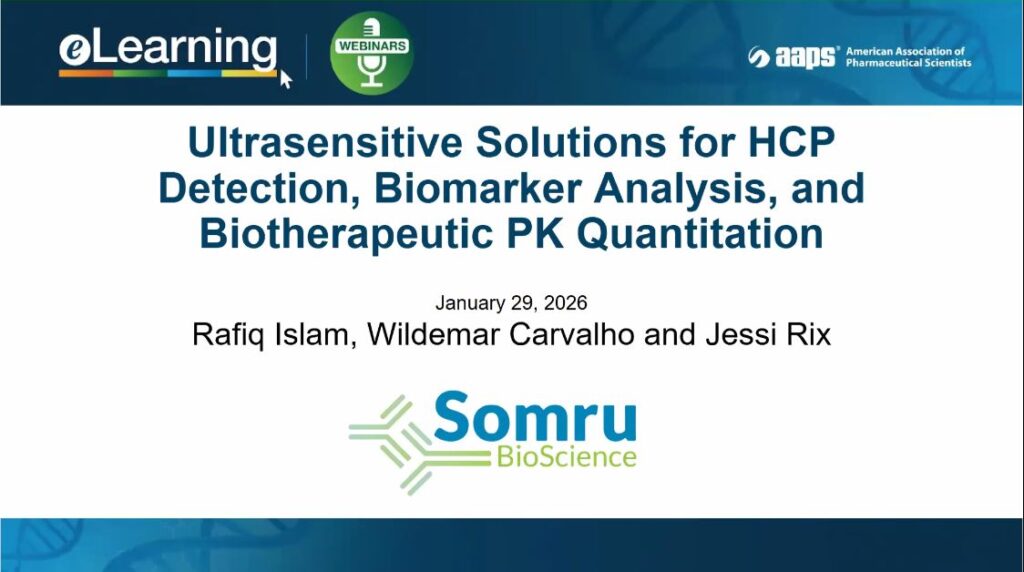
Ultrasensitive bioanalysis and machine learning

Now Streaming On-Demand While significant advances have been made in terms of ultra-sensitive technology platforms for measurement of biologics and biomarkers, most platforms requires high capital investment and significant re-work of existing immunoassays. We present case studies where we are able to adapt the current ELISA methods to achieve 5-50x more sensitivity. The adaptation involves utilization of nanoparticle enabled immune-PCR in combination with machine learning augmented design of experiment (DOE) to deliver robust immunoassay method. Why Machine Learning DOE? Immunoassay methods are highly variable and impacted by numerous assay parameters and conditions. Current approach is to utilize trial and error approach – one factor at a time. Due to lack of understanding among variables/factors, when a reagent changes it is difficult to troubleshoot methods. It is difficult to describe these variables even with high degree of mathematical structures. Due to high number of variables impacting immunoassays, DOE by itself very time-consuming and expensive process. As the complexity of the methods increases, it requires expert knowledge to define numerous parameters and options and to analyze the data. Existing experimental design methods such as the classical techniques, Taguchi methods, and response surface methodology is not adequate to model the representation of many underlying multi-response ELISA problems and is not adequate to provide decision support. Decision Support System Design of Experiments (DOE) is a statistical method used to determine the cause-and-effect relationships between different factors in a system. Machine learning, on the other hand, is a field of within Artificial Intelligence that focuses on developing algorithms and models that can learn and make predictions based on data. DOE can help identify the important factors that affect the performance of a system, and machine learning algorithms can then be used to develop models that predict the performance of the system based on those factors. We have developed a Decision Support System (DSS) that utilizes DOE to identify the factors that affect the quality of the method , such as the temperature, antibody concentrations, and incubation time etc. Machine learning algorithms can then be trained on the data from the DOE to develop models that can predict the ideal conditions based on historical data and ongoing DOE data             Watch Now! Complete the form to view the recording.  
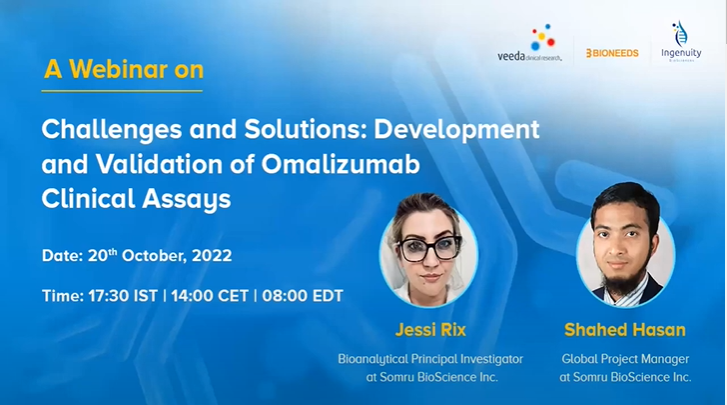
Webinar Challenges & Solutions: Development and Validation of Abatacept Biosimilar Clinical Assays

Now Streaming On-Demand The webinar began with an introduction to abatacept, its mechanism of action, and its clinical indications. The speaker then discussed the challenges faced in the development of abatacept biosimilars, including analytical and clinical challenges. The speaker also provided an overview of the regulatory landscape for abatacept biosimilars and discussed the key requirements for demonstrating bioequivalence. He highlighted the importance of a comprehensive approach to bioanalysis, including preclinical studies, analytical method development, and clinical trial design. The webinar also featured case studies illustrating the challenges and solutions encountered during the development and validation of abatacept biosimilar clinical assays. The speaker shared his experiences in overcoming these challenges and offered insights into best practices for assay development and validation. The webinar concluded with a question and answered session, providing attendees with the opportunity to ask the speakers for clarification on any of the topics discussed. The session provided a valuable opportunity for attendees to learn about the latest approaches and solutions in the development of abatacept biosimilar clinical assays.             Watch Now! Complete the form to view the recording.